
Key Takeaways
•The short answer: Choose Back Bay for full-service towers, elevators, garage parking, and lock-and-leave ease. Choose Beacon Hill for quiet historic streets and a lower median sale price — the median being the middle price, with half of sales above it and half below.
•The price gap is real but it isn't apples-to-apples: Back Bay's March 2026 median sale price was $1.434 million versus Beacon Hill's $1.16 million — about $274,000 apart, per Michelle Roloff Real Estate. Part of that reflects bigger, newer, full-service buildings.
•Both are condo markets: In either neighborhood you are choosing a building and a fee structure, not a lot and a lawn.
•Bottom line: Treat the median as one input among several, then buy the building type that matches how you actually live.
If you are comparing luxury condos in Boston, here is the most important truth:
Back Bay and Beacon Hill share prestige, history, and prices close enough to compare directly — but they deliver very different days.
Back Bay gives you polish, scale, services, and city energy. Beacon Hill gives you quiet streets, historic charm, and a more intimate rhythm.
You are not choosing "better." You are choosing public grandeur or private hush.
What does the Back Bay premium actually buy you?
Back Bay's biggest advantage is its range of condo buildings. You can find classic brownstones, but also full-service luxury towers like One Dalton and the Mandarin Oriental. Beacon Hill doesn't have that hotel-style product at scale.
Back Bay is stronger for buyers who want:
•Elevators and single-level layouts
•24/7 concierge and package handling
•Underground parking and roof decks
•Professional management when they're away
This is the lock-and-leave choice. Split time between Boston and another home, and that service package can be worth the premium — you're paying for convenience, not just an address.
Back Bay also offers more layout variety. According to Michelle Roloff Real Estate, current listings run from studios as small as 175 square feet up to multi-bedroom condos of 4,000 square feet and more.
The tradeoff: Back Bay is busier, parking is more competitive, and monthly condo fees can climb steep in service-heavy buildings. So the real question isn't "Can I afford Back Bay?" It's "Will I use what I'm paying for?"
Skip the car altogether, and Back Bay delivers a perfect 100/100 Transit Score.
Back Bay vs Beacon Hill Mobility Scores
Neighborhood comparison of walk, transit, and bike scores for Back Bay and Beacon Hill.
Walk Score
Transit Score
Bike Score
| Series | Label | Value |
|---|---|---|
| Walk Score | Back Bay, MA | 86/100 |
| Transit Score | Back Bay, MA | 100/100 |
| Bike Score | Back Bay, MA | 74/100 |
| Walk Score | Beacon Hill, MA | 79/100 |
| Transit Score | Beacon Hill, MA | 89/100 |
| Bike Score | Beacon Hill, MA | 100/100 |
Beacon Hill counters with a perfect 100/100 Bike Score. Neither neighborhood requires a car; the difference is how you'd move — trains and buses on one side, walking and biking on the other.
Is Beacon Hill the lower entry point, and what does it ask of you?
Yes — at the median sale price. That's your bargaining room.
Back Bay's March 2026 median sale price was $1.434 million, while Beacon Hill's was $1.16 million, per Michelle Roloff Real Estate: about $274,000 apart. That gap can buy renovation budget or a stronger cash position.
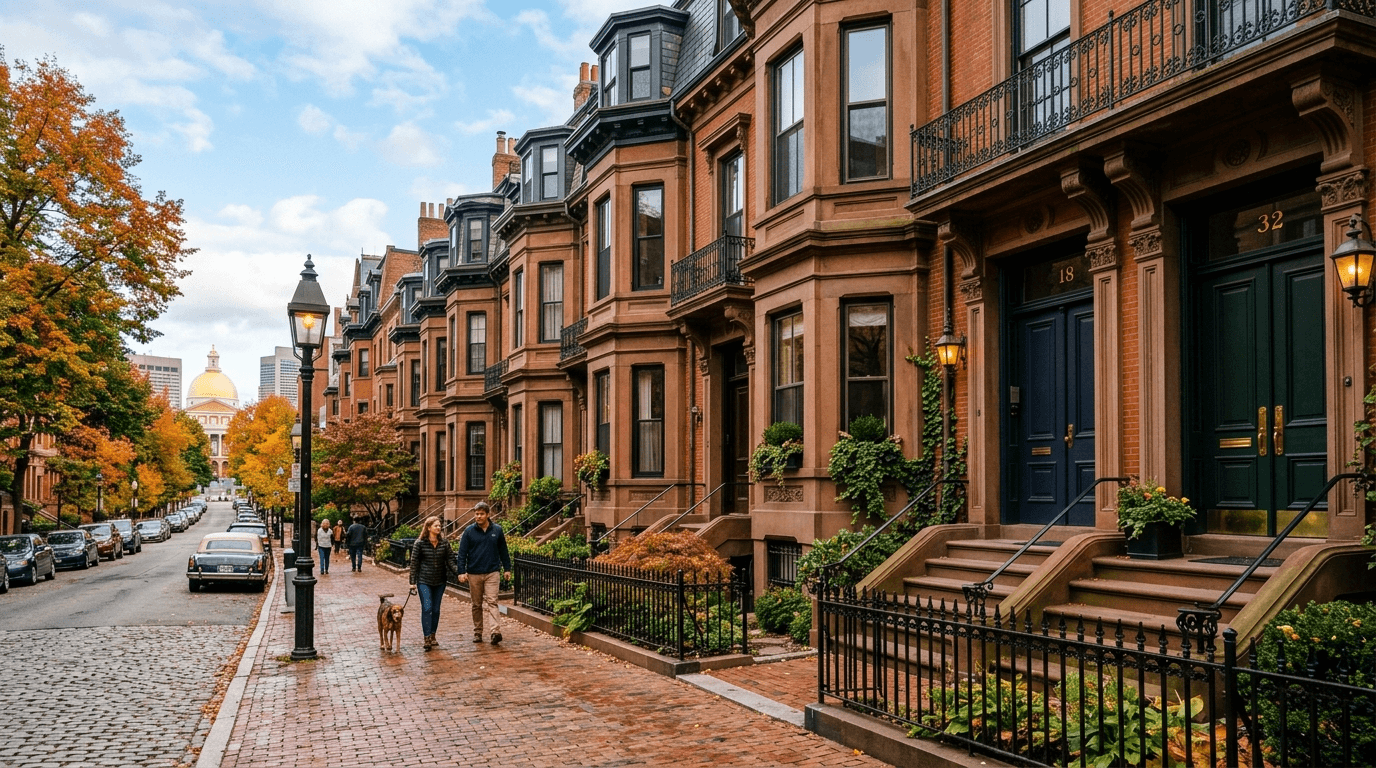
But Beacon Hill asks something in return. You get one of Boston's most beloved streetscapes — red brick, gas lamps, ironwork, and Charles Street as the neighborhood's living room. You also get smaller homes on average. Michelle Roloff Real Estate lists current Beacon Hill studios at 235 and 311 square feet, with one-bedrooms around 515 to 619 square feet.
Beacon Hill also has fewer elevators, fewer garages, and less concierge service. Call it a stewardship purchase — a home you take care of yourself, not one a staff takes care of for you.
Safety is one place where Beacon Hill stands out sharply. It carries an A safety grade with low violent and property crime, while Back Bay grades D+ with moderate ratings on both.
Back Bay vs Beacon Hill Safety Profile
Qualitative safety and environmental comparison between Back Bay and Beacon Hill.
| Category | Back Bay, MA | Beacon Hill, MA |
|---|---|---|
| Safety Grade | D+ | A |
| Violent Crime | Moderate | Low |
| Property Crime | Moderate | Low |
| Flood Risk | Low | Low |
| Air Quality | Good | Good |
Walk home late from the Financial District, and that difference stops being theoretical.
What are the strongest arguments against focusing on the $274K gap?
Objection 1: A higher median may reflect a different mix of homes, not more expensive space.
Fair. Back Bay has more large, full-service, high-amenity condos, and those push the median up. Michelle Roloff Real Estate reports Beacon Hill at about $1,330 per square foot in March 2026. Ask your agent for the matching Back Bay figure before treating the $274K gap as a price-per-square-foot premium. Until then, treat it as a budgeting gap, not proof that identical space costs more in Back Bay.
Objection 2: The price figures come from brokerage sources, and they vary.
Also fair. Andrew Goldberg Advisory reports a Beacon Hill median of $984.5K for the full first quarter of 2026. Michelle Roloff Real Estate reports $1.16 million for March 2026 alone. Different window, different mix of sales. Treat Beacon Hill as a range rather than one fixed number; both figures still land below Back Bay's March median.
Objection 3: Above $2M, availability matters more than price.
This is the objection the price data can't answer. Nothing in the medians tells you whether the unit you want even exists this month. Say your must-haves are narrow — elevator, two-car parking, 2,000-plus square feet. Then the $274K gap means nothing until you confirm units like that are actually for sale in both neighborhoods. Ask your agent for the current count of active $2M-plus condos in each before you pick a side.
What should you verify before you tour?
Before you fall for a view or a gas-lit street, model the full annual cost.
In a Back Bay tower, look closely at condo fees, taxes, insurance, parking costs, and special assessments — one-time bills owners get when the building needs a big repair. Premium services often come with premium monthly costs.
In a Beacon Hill brownstone, inspections matter even more: structure, masonry, and pilings — the wooden posts many older Boston buildings sit on. Deferred maintenance hides easily behind charm.
If your building sits in a protected historic district, exterior changes may require commission review. Ask your agent to confirm the current rules for that specific address before you plan any work — and before you buy on the strength of a renovation dream.
Own here part-time or live out of state, and it's worth knowing that Massachusetts taxes a non-resident's estate only on property located in the state, not on everything they own — that's per the Boston Business Journal, May 1, 2026. On a multimillion-dollar condo, that's worth a call to your estate attorney.
Which high-end Boston style fits you best?
Start in Back Bay if you want concierge service, garage parking, elevators, roof decks, broad boulevards, and the freedom to leave town for a month.
Start in Beacon Hill if you want quiet prestige, historic texture, top-tier safety, and a more hands-on relationship with your home.
Before you tour, ask yourself five questions:
1. How much square footage do I truly need?
2. Do I require an elevator?
3. Do I plan to renovate?
4. Do I own a car?
5. Do I want energy outside my door, or quiet?
Use the $274K gap as bargaining room, not a verdict. That money can buy a larger Beacon Hill footprint, or help justify the Back Bay service package.
Before you write an offer, ask your agent for two things: recent closed sales in the same building type, and a full carrying-cost model. Then compare real units side by side — not neighborhoods on paper.